A custom visor looks like one of the simplest items you can put a logo on, and that is exactly why so many orders go sideways. The blank is cheap, the setup is fast, and the decisions feel low-stakes right up until a box of 200 shows up with a logo that curls off the foam or a fabric that soaks through by the second inning. Most of the regret is avoidable. The mistakes below are the ones that turn a routine reorder into a reprint, and each one is easy to design out before you approve the order.
Matching the fabric to the weather it will actually live in
The single most common mismatch is ordering a cotton visor for a hot, sweaty environment. Cotton twill feels great in hand and takes embroidery cleanly, which is why it dominates catalog thumbnails, but it holds moisture and dries slowly. For a golf scramble in July, a distance race, or a poolside resort desk, a 100% polyester or poly-spandex performance blend is the better call: it wicks, dries fast, and resists the salt rings that show up on cotton after a few wears. Save cotton and cotton blends for cooler, lower-exertion settings where the softer look and hand matter more than sweat management. If you are buying for a mixed program, it is usually cleaner to standardize on a performance poly across the board than to sort visors by event later.
Color behavior matters too. Light fabrics keep heads cooler in direct sun and show crisp logo contrast, but they also show sweat and dirt faster, which shortens the visible life of a giveaway piece. Darker crowns hide wear but run hotter. Neither is wrong; the point is to choose deliberately rather than defaulting to whatever swatch photographed best.
Treating “one size fits all” as if it truly fits all
Nearly every stock visor is sold as one size with an adjustable closure, usually hook-and-loop and occasionally an elastic or buckle band. That closure covers a wide range of adult head circumferences, but it is not universal. Youth programs, in particular, get burned here: an adult one-size visor sits loose on a ten-year-old and slides during play. If any part of your audience is a kid, confirm a youth size exists before you commit the whole run to one spec. For adult crowds, hook-and-loop is the safe default because it adjusts on the fly and survives repeated tightening; buckle closures look cleaner but flex less. Ask for the closure type in writing rather than assuming, because it is the kind of detail that quietly varies between blank styles even within the same catalog.
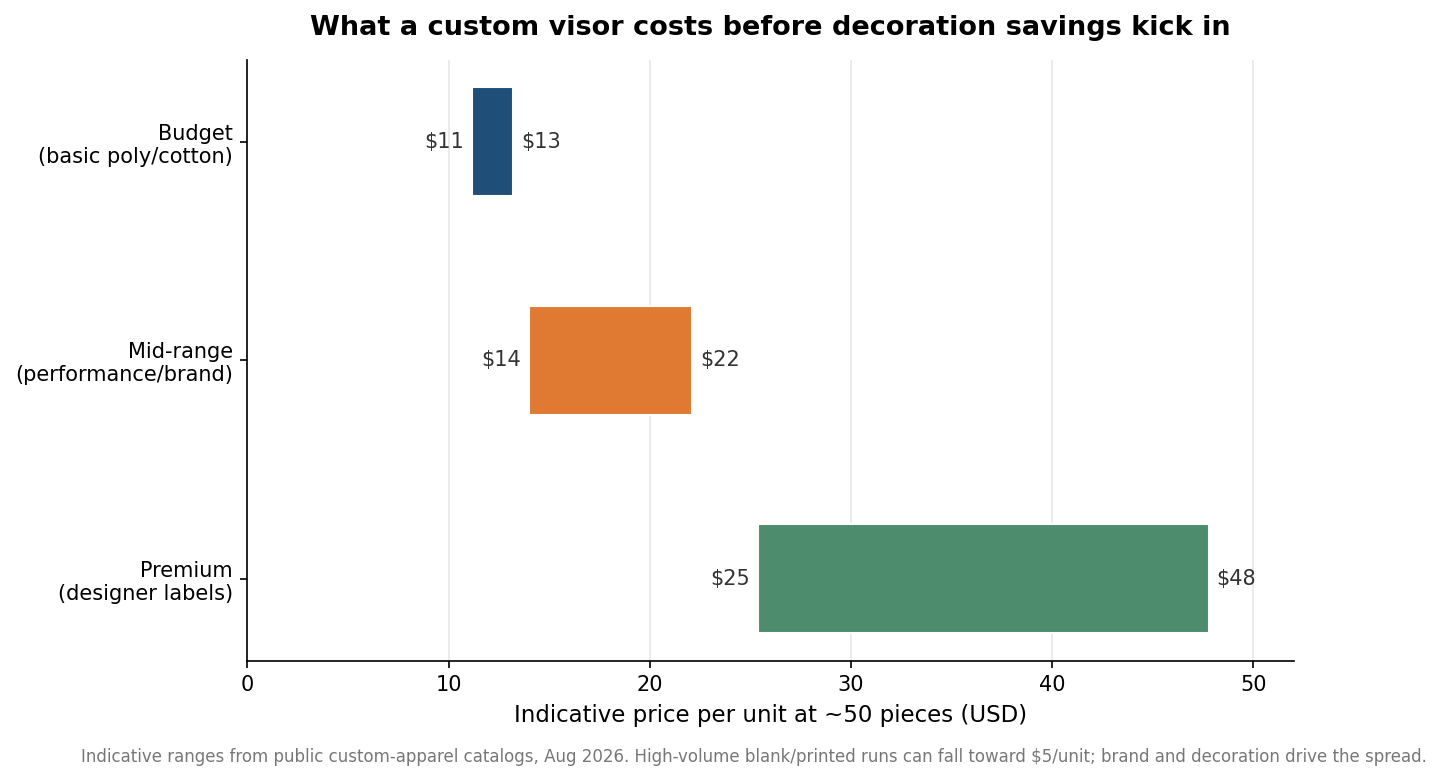
Price is the other place the “it’s simple” assumption bites. At around 50 pieces, a basic poly or cotton visor lands in roughly the $11 to $13 range, mid-range performance and name-brand blanks run about $14 to $22, and premium designer labels climb well past $25 and toward $45 or more before you even add stitching. Those are indicative catalog figures rather than a quote, and they move with decoration and brand, but the shape holds: the blank you pick sets your floor, and premium labels can triple your unit cost for a difference most recipients will never notice on a giveaway.
Choosing a decoration method for looks instead of lifespan
Embroidery and printing are not interchangeable, and picking on appearance alone is how logos end up wrong for the job. Embroidery gives a raised, textured, premium look and shrugs off washing and sun for years, which suits corporate gifts, resort staff, and anything meant to last a season or more. Its limits are small text and fine gradients: thin lettering and detailed artwork can blur into thread, and a dense design adds cost and a little weight to a light foam or fabric front. Printing, whether heat transfer or sublimation, reproduces gradients, photos, and small type that embroidery cannot, and it is the right choice for full-color art or tiny sponsor lockups. The trade-off is durability; a print will show wear sooner than stitching under heavy sun and repeated washing.
There is a minimum-order wrinkle worth planning around. Embroidered visors typically carry a small floor, often around six pieces, while printed and blank items are frequently offered with no minimum at all. That rarely blocks a real order, but it matters if you are testing a design with a handful of samples before committing to volume.
Getting the quantity and timeline math wrong
Two numbers decide whether an order feels smart or stressful: how many you buy and when you need them. On quantity, the per-unit price falls steadily as volume rises, and high-volume printed runs can drop toward the $5 range, so ordering slightly over your headcount is often cheaper per piece than a tight reorder later, especially once setup and art fees are spread across more units. Buy a sensible buffer for staff turnover, giveaways, and the inevitable few that walk off, but resist over-ordering a dated design you cannot reuse.
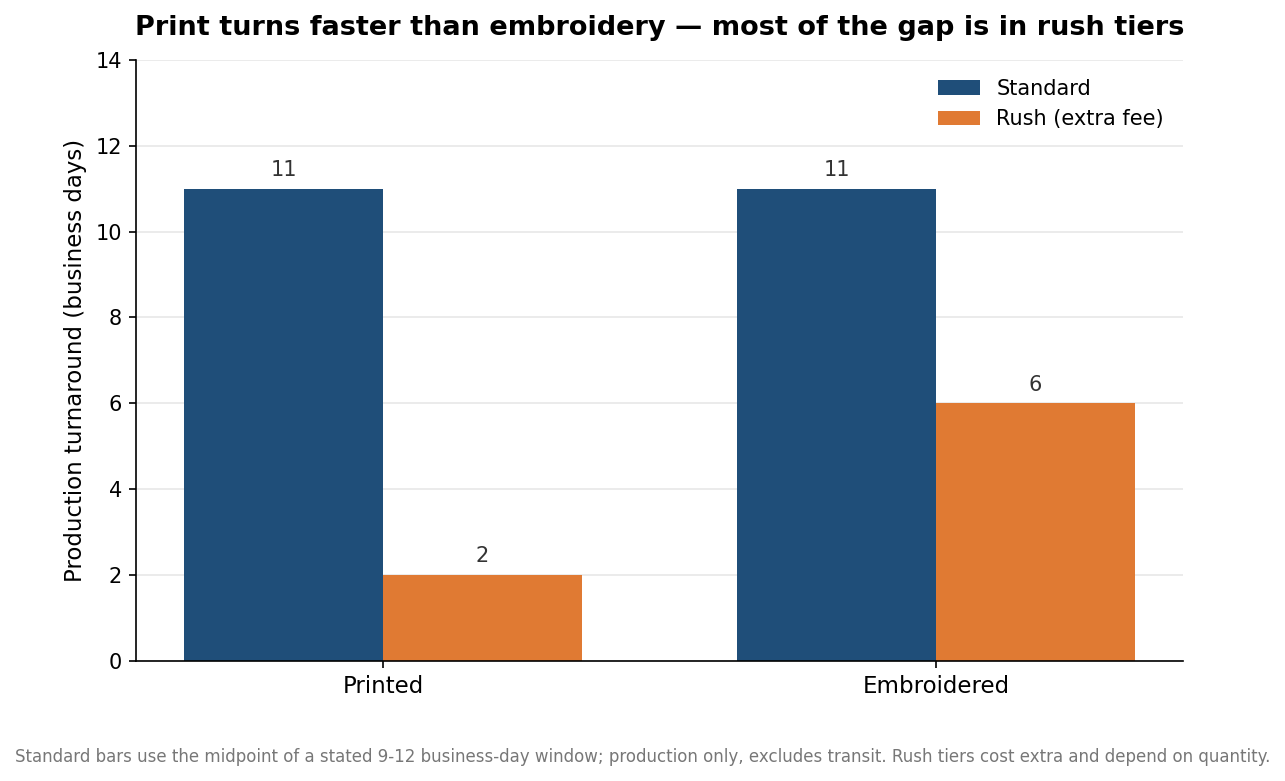
On timeline, build backward from the event and add margin. Standard production commonly runs about nine to twelve business days, and that is production only, before transit. Rush tiers exist and are genuinely fast, with printed rush as quick as a couple of business days and embroidered rush around six, but they cost extra and get tighter as quantity climbs. The teams that avoid rush fees are simply the ones that approve art two to three weeks out. If your date is fixed, order the moment the artwork is final rather than waiting on a headcount you can round up later.
Skipping the proof that catches the expensive errors
Approve a digital proof, and for embroidery ask about a sew-out or stitch preview before the full run. This is where you catch a logo that is too wide for the front panel, thread colors that drift from your brand, or a print placement that rides too high on the bill. A visor has a narrow, curved decoration area, so artwork that looks fine on a screen can crowd the edges once it is scaled to the panel. Confirm the exact placement, the finished decoration dimensions, and the thread or ink colors against your brand references in the proof stage, when a change costs nothing. The reorder you never have to place is the cheapest visor you will ever buy, and it almost always comes down to five minutes spent reading the proof carefully.